
Truck Courts and Dock Aprons in Brownsville
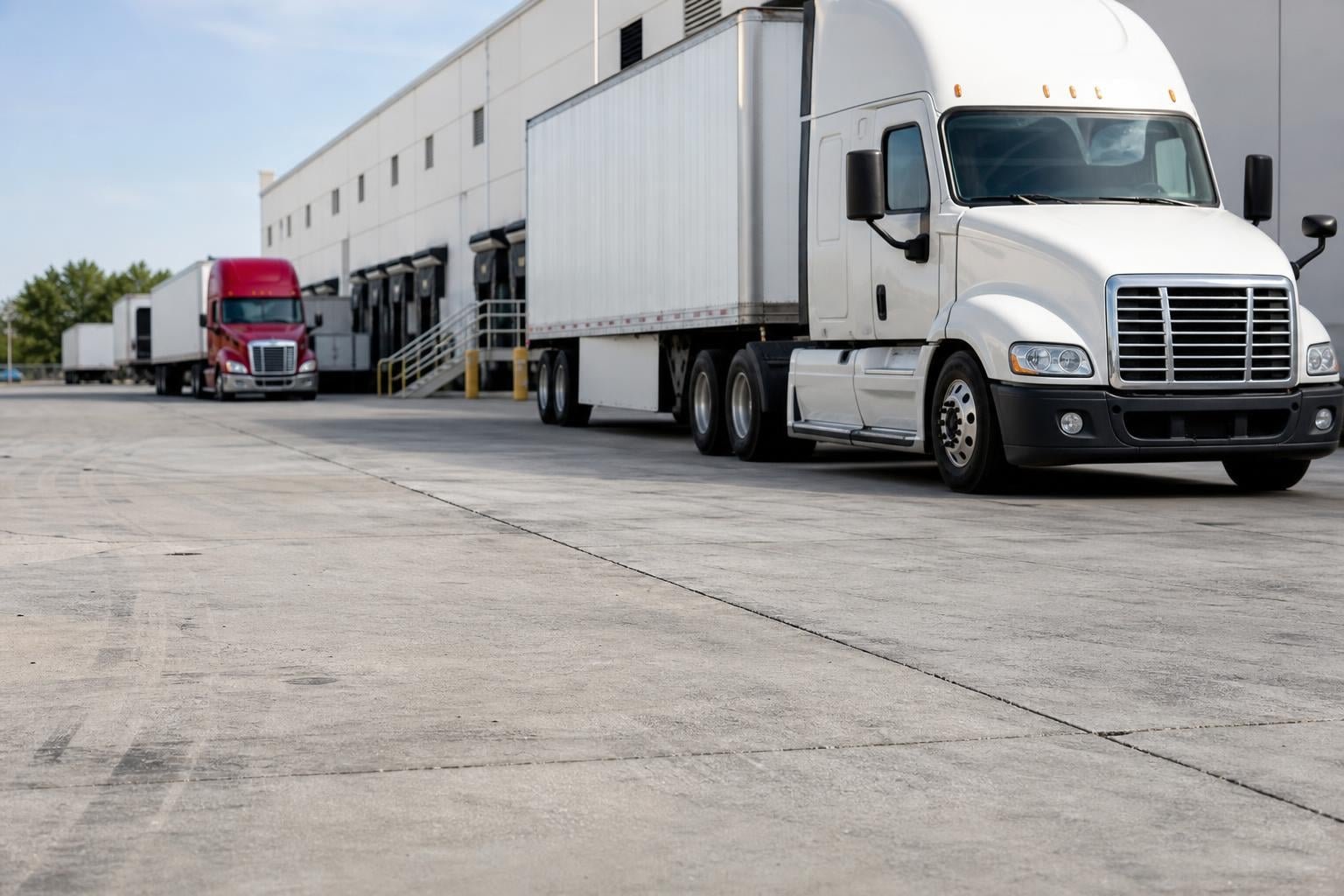
Eight hundred trucks a day is roughly what a reference article reports for the county-owned Veterans International Bridge at Los Tomates in 2019, out of an average of about 4,000 vehicles, and every one of them eventually needs somewhere to turn, park, back into a dock and leave again. Truck courts and dock aprons are the pavement where that happens. They are the least glamorous part of an industrial site and the part most likely to fail first.
The reason is simple: concrete and asphalt built for cars does not survive the repeated loading of a fully laden tractor-trailer. Trailers stop and start in the same spots, landing gear punches into the surface, dolly legs concentrate load on small patches, and dock leveler pits and approach slabs see shock loads all day. A court that looks fine at turnover can be rutted and broken within two years if the design or the construction was marginal.
We build truck courts, dock aprons, trailer storage areas and approach drives for warehouse, distribution, manufacturing and cross-dock owners in Brownsville and nearby. This page describes what we do and how we decide.
Freight volumes shape the pavement
The Trade & Industry Development profile of the Port of Brownsville reports 450,000 truck movements in 2024, along with 2,322 vessel calls and 95,000 railcar movements. The port is also described as 7 miles by truck from international crossings. That is serious tractor-trailer traffic in a region where the roads leading to a site, including State Highway 550 and the I-169 corridor that runs beside it, are part of a planned interstate link between the port and I-69E.
For a building owner, this means trucks will arrive in numbers, and many will come from carriers who are not familiar with the site. Turning paths, queuing space and one-way flow become real design issues. The county-owned bridge has a dedicated truck lane, so freight that crosses there lands on the same highways your drivers use. We read the traffic projections in the site plan and ask how many loads per door per day the tenant expects, because a court sized for casual use will not carry a cross-dock operation.
Subgrade, drainage and the choice of concrete or asphalt
Most truck courts built for heavy repeated loads use reinforced concrete, at least in the dock approach and the trailer parking positions. Asphalt can serve for drive lanes and lightly used areas but softens in heat and rutting, and diesel spills attack it. A hybrid, with concrete aprons and asphalt travel lanes, is common and sometimes the sensible budget choice. We lay out the options and the life-cycle cost of each.
The ground is the other half of the answer. Valley clay soils are mostly clay to silty clay loam, so the subgrade usually receives moisture conditioning, a stabilized layer or select fill. Water must leave quickly, because a standing pool beside a dock door leads to pumping, joint failure and slick surfaces. We coordinate the pavement slopes with the stormwater and drainage design so inlets, trench drains and swales work with the courts.
Where the money goes
Slab thickness and reinforcement lead the budget: a court designed for loaded trailers uses a thicker section than a parking lot, often with dowelled joints and heavier steel. Pavement area comes next, since truck courts require generous turning radii and staging space. Subgrade treatment, joint sealing, and the number of dock-edge pits and approach ramps add further cost.
Schedule matters, too. Concrete placed in cooler months cures more predictably, and a project that needs the dock open by a fixed date may need weekend pours or accelerated mixes. We can price alternates for different thicknesses or pavement types so you can see the difference in first cost and long-term maintenance. Often, spending a little more on the dock approach saves repair shutdowns later.
Building the court so it stays flat
We start with an accurate grade and a firm, uniform subgrade. Forms are set to line and elevation, dowels and tie bars are placed at the right spacing and the concrete is poured, finished and cured in a pattern that controls cracking. Saw cuts follow quickly. Edges at dock positions get extra attention, since leveler pits, bumpers and canopy footings connect to the same slab.
We walk the finished surface with the superintendent and a level to check for ponding before the owner does. Truck courts tie into your main building floor and sometimes into the larger parking lot construction package, so we keep elevations and joint patterns coordinated across both. The owner's final inspection includes a rain walk if weather allows, because water shows what a level cannot.
Who we build truck courts for
Our clients include logistics and distribution operators, manufacturers shipping product and developers building speculative buildings in the port area and along the I-69E and I-169 corridors. A truck terminal or cross-dock is the most demanding case, with continuous, high-frequency loading around the clock.
Each of these owners has a different priority. A developer building for an unknown tenant wants flexibility and a reasonable cost. A manufacturer wants the court sized to its shipping pattern. A logistics operator wants pavement that survives intensive use and fast repair. We build to the actual operation, not to a generic spec.
Plan the truck court with your dock layout
Send us your site plan and expected truck counts. We will review turning paths, subgrade and drainage and give you a firm price for the pavement section that suits your operation.
Questions Owners Ask
Concrete or asphalt for a truck court?
For dock approaches and trailer parking that sees repeated heavy loading, concrete is usually the better long-term choice. Asphalt may serve for lightly used drive lanes. The decision is financial as well as technical, and we price both so you can compare first cost and lifetime maintenance.
How thick should the slab be?
Your civil or structural engineer sets it from the expected truck loads, subgrade strength and traffic volume. Truck court slabs are commonly much thicker than car parking slabs and use dowels at joints. We build to the engineer's design and are happy to discuss alternatives when you have value-engineering questions.
Can you replace a failed dock apron while the building operates?
Yes, usually in phases. We plan temporary dock closures, alternate truck routes and nightly or weekend pours. It takes coordination with your operations manager, which we do before starting. For more on this approach see our work on phased construction on occupied sites.
What causes the cracks that appear at dock doors?
Typically loading stress, joint spacing that is too wide, poor subgrade support or restraint against the building floor. A well-detailed isolation joint and proper dowels reduce them. We also cure the concrete promptly, since early moisture loss weakens the surface.
How long before trucks can use the new court?
Light vehicles after a few days, but fully loaded trucks should wait until the concrete has reached the specified strength, normally about a week or more depending on the mix and temperature. We confirm with cylinder tests before releasing the court.
Related
Related Services
Related Building Types
Related Industries
Ready to talk about your project?
Request a Project ReviewPlanning a build in Brownsville or Cameron County?
Share the site, the building and the schedule. We will walk the drainage, soils and permit path with you and follow up with next steps.